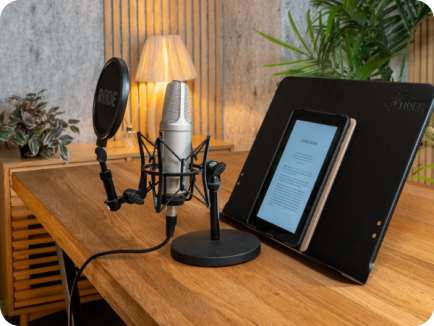
Available Across Digital Storefronts
A well-built EPUB can be prepared for major ebook retailers without creating a completely different book for each one. Retailer-specific checks still matter, but the source remains controlled and reusable.

Tell us which stages your book still needs and we will quote the whole set in one place.
Request a single quoteA good ebook should feel simple to read. Our ebook formatting services turn a finished manuscript into a structured digital edition that can resize cleanly across phones, tablets and e-readers. We build the file properly, test the reading experience, and prepare it for the storefronts named in your scope.
The work follows a clear order. Before conversion starts, we agree the ebook format, the target retailers, the reading experience and the scope in writing so there are no surprises halfway through production.
Most novels and straightforward nonfiction belong in a reflowable EPUB, where text adjusts to the screen and the reader can change the font size. Image-led books may need fixed layout instead. We make that decision before production starts because the wrong route creates problems that only become obvious during ebook preview testing.

A manuscript may look tidy in Word while still being built with manual spaces, empty paragraphs and visual-only headings. Those shortcuts do not convert reliably. We rebuild the source around real paragraph and character styles first, giving the EPUB a stable structure instead of trying to repair broken formatting after conversion.
Navigation is part of the reading experience, not an afterthought. We agree the table of contents depth, internal hyperlinks, footnote behaviour, image sizing, table treatment and chapter openings before the file is built. That makes the finished ebook easier to use and prevents small technical decisions from becoming reader complaints later.
Your written scope names the layout route, file outputs, retailer targets, revision rounds, accessibility work, schedule and ebook formatting cost. If something sits outside that scope, we price it separately before doing it. The point is simple: you should know what is being built and what you are paying for before conversion begins.
We validate the EPUB, then open it on actual reading devices and apps at different font sizes. This catches problems that automated checks can miss, such as awkward breaks, oversized images, weak navigation or headings that separate from the text they introduce. The file is corrected before delivery, not after a reader reports it.
An ebook can be distributed without a print run, corrected after publication and read on devices that let readers adjust type size and contrast. None of that works well if the underlying file is badly structured. Proper ebook formatting makes the edition easier to read, easier to update and more reliable across the stores where it is sold.
A well-built EPUB can be prepared for major ebook retailers without creating a completely different book for each one. Retailer-specific checks still matter, but the source remains controlled and reusable.
Reflowable text can resize, rewrap and work with screen readers. That flexibility depends on structure, heading levels, image descriptions and a reading order that makes sense when the page disappears.
If a typo or metadata issue is found later, the digital edition can be updated without replacing stock. We keep the production source organised so corrections do not require rebuilding.
There is no warehouse or print quantity attached to an ebook edition. The commercial model is different from print, so authors keep a digital edition alongside paperback and hardcover formats.
You may have a finished manuscript, an older EPUB, a Kindle file that behaves badly, or a print document that was never designed for digital reading. We review what exists first. Then we tell you whether the book needs a repair, a fresh reflowable EPUB, or a more specialised layout route before any production work is quoted.
We begin by looking at the manuscript, its reader and the stores where the ebook will be sold. From that comes a short production plan covering reflowable or fixed layout, images, tables, navigation and retailer requirements. The file is built around those decisions instead of around a generic export setting.
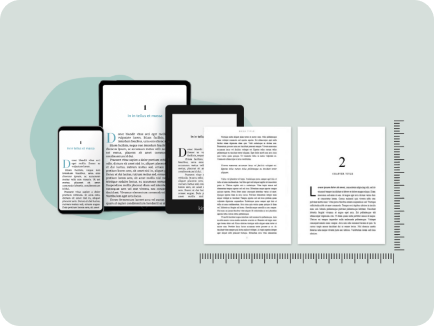
The source document is rebuilt with real styles so the ebook has a reliable hierarchy. Manual indents, empty-line spacing and improvised page breaks are removed. This stage is quiet work, but it is what gives later EPUB and Kindle formatting a clean foundation.

The structured manuscript becomes a semantic EPUB with a working table of contents, internal hyperlinks, properly sized images and accessibility metadata. Footnotes and endnotes are handled according to the format and retailer support. For Amazon KDP, the EPUB is prepared so Kindle conversion has a clean source to work from.

We validate the finished EPUB, inspect it in ebook preview tools and test it on real devices. Font size, navigation, chapter openings, images and tables are checked under practical reading conditions. Retailer-specific versions are prepared where needed, then the final files are delivered with the source materials defined in your scope.
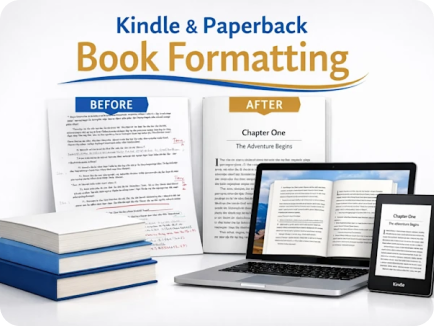

A professional ebook should not depend on one screen size or one reading app. We build and test the file so headings, paragraphs, images, internal hyperlinks and the table of contents continue to work when the reader changes device or font settings.
Reflowable EPUB and fixed-layout work are scoped separately because the production requirements are genuinely different.
Amazon KDP accepts EPUB and converts it for Kindle delivery. We prepare the source for that process, check the reading experience, and keep legacy MOBI considerations in context rather than treating an old file type as the current standard. Kindle Create may suit some simple books, but it is not the right tool for every manuscript.
You retain the source files, digital rights and retailer accounts. The production service does not acquire your book.
The recipes depended on ingredient lists, images and instructions staying visually connected. A standard reflowable ebook would have broken those relationships on smaller screens, so the main edition used fixed layout. We also prepared a simpler reflowable version for platforms and readers where fixed layout was less practical.
Read More
The text was fine. The ebook was not. Chapters opened in the wrong places, indents shifted from device to device, and the table of contents did not work. We returned to the manuscript, rebuilt the styles and created a fresh EPUB. The result looked ordinary in the best possible way: readers could focus on the story instead of the formatting.
Read More
The print edition relied on footnotes, bibliography references and page-based indexing. In a reflowable EPUB, those print page numbers no longer meant anything, so the navigation had to be rebuilt. Notes were linked appropriately, citations connected to the bibliography, and the index was adapted for digital use rather than copied mechanically from print.
Read More
Summaries of work carried out in house. Titles, authors and publication details are withheld under the confidentiality terms of the productions.
Audio, electronic and print editions solve different production problems. We scope them separately so you can choose the format you actually need and understand what changes when a manuscript becomes a recording, an ebook or a printed book.
They cover the work between a finished manuscript and a digital file that readers can use comfortably. Depending on the book, that includes source cleanup, EPUB formatting, Kindle preparation, internal hyperlinks, table of contents setup, image handling, accessibility metadata, validation and device compatibility testing. The exact deliverables are written into your scope.
You can, but the result depends on how the Word file was built. Manual spacing, fake indents and empty paragraphs often convert badly. If you want to format a book for Kindle reliably, the better route is to clean the source structure first and then test the resulting ebook rather than assume the automatic conversion will look right.
A reflowable EPUB lets text resize and rebuild itself for the reader's screen, which suits most novels and nonfiction. Fixed layout preserves page position, so it is better for some picture books, comics, cookbooks and highly designed titles. The trade-off is less flexibility and uneven support across devices, so we choose the route based on the book rather than habit.
A validated EPUB 3 is the normal master because major retailers, including Amazon KDP, can ingest it. Your scope may also include retailer-specific variants or other working files. MOBI is treated as a legacy format where an existing distribution workflow still requires it, not as the default output for new Kindle ebook formatting.
Yes. Proper heading structure, declared language, meaningful alt text, logical reading order and accessibility metadata are part of a professional ebook build. These choices also make the file more robust across reading apps and assistive technology.
Ebook formatting cost depends on the condition of the source and the complexity of the book. A clean, text-led reflowable EPUB is simpler than a title with tables, hundreds of notes, heavy illustration or fixed layout. We review the manuscript first and quote the actual production route in writing before work begins.
Images are prepared for screen use and given appropriate alt text. Tables are reviewed for small screens because wide layouts can become unusable on a phone. Internal hyperlinks, notes and the table of contents are tested as part of the ebook preview so navigation works rather than merely existing in the file.
Usually. We inspect the existing EPUB or Kindle source and decide whether the structure can be repaired or whether a clean reconversion from the manuscript will be faster and safer. You get that recommendation before a rebuild is quoted.
The scope can cover Amazon Kindle, Apple Books, Kobo, Google Play, Barnes & Noble and other ebook channels. Each store has its own checks and account choices, so distribution is confirmed separately from the formatting work. You keep control of the retailer accounts and decide where the edition is sold.
The front cover artwork can usually be prepared for ebook retailers, but the full print wrap cannot be used because an ebook has no spine or back cover. If the only file available is a print-ready wrap, we can extract and prepare the front panel where the source quality allows it.
Amazon does not require you to supply an ISBN for a Kindle ebook, while other channels may use different identifier rules. If you want the digital edition listed under your own imprint across multiple retailers, we can explain the identifier options during setup rather than making the decision for you.
You do. The source files and rights described in your written agreement remain yours, and retailer accounts stay in your name. The service covers production and formatting; it does not transfer ownership of the book or claim a share of your royalties.
Bring us the manuscript, EPUB or Kindle file you already have. We will tell you whether it needs a small repair, a fresh reflowable EPUB, Kindle formatting, or a different production route, then put the scope and cost in writing before work starts.